Showing posts with label preston. Show all posts

Friday, 8 July 2016

"Now Picture That" - Preston - cotton

"Now Picture That" is a series of posts which share old engravings and photos of Britain to help you imagine how things looked in times gone by.  

This print gives a great visual of Preston's cotton factories and chimneys in 1862.  What is more interesting though is the activity in the foreground.

The American Civil War (1861-1865) had a direct impact on Lancashire's economy.  The raw cotton from the American cotton plantations was blockaded which resulted in the shutdown of Lancashire mills who had no raw material to work with.  Thousands of unemployed cotton workers were put back into employment through public work schemes.  This image shows the Preston mill-hands being used to landscape Preston Moor Park.  The park had existed since the 1830s, but had limited public access.  Under this back-to-work scheme there were extensive alterations.
Similar work was done at the same time in the development of two other Preston parks, namely Avenham Park and Miller Park.

Original print has the title: "The Distress in Lancashire - Mill-hands at work on Preston Moor."
From the Illustrated London News, 1862.

Friday, 1 July 2016

"Now Picture That" - Preston - Market Place

"Now Picture That" is a series of posts which share old engravings and photos of Britain to help you imagine how things looked in times gone by.  
Preston’s Market Square has stood at the heart of the region’s economy for centuries. 
The Obelisk, erected in 1782, originally had a stone orb on the top which was replaced by a gas burner in a glass globe.   The gas pipe ran inside the stone column.  In 1853 the obelisk was removed from the square and was, quite ingloriously, used as gate posts at Hollowforth Hall in Woodplumpton.  Some 126 years later it was restored to its former glory, and on the 10th May 1979 her Majesty the Queen unveiled the restored obelisk as part of the 800th anniversary celebrations of Preston’s first Royal charter.
In the background stands some delightful half timbered buildings built around 1629.  These were cleared away in 1857 to make way for the new Town Hall.

Take a FREE tour of this market place with a self guided tour app found via www.obelisktours.com

Friday, 17 June 2016

"Now Picture That" - Preston - Old Engraving

"Now Picture That" is a series of posts which share old engravings and photos of Britain to help you imagine how things looked in times gone by.  
This image looks from Penwortham Hill (site of an ancient, disappeared castle & abbey) across the River Ribble to the town of Preston.   The chimneys of the cotton works are a noticeable part of the town's skyline, but note also the windmills.   Early cotton production, and notably  Richard Arkwright's water frame, needed a source of power to keep it going.  In the absence of any fast moving streams in the area hand, horse or windmill were used.  Today only one base of these windmills survives at Craggs Row Mill.


From a Steel Engraving by J. Harwood & R. Winkles.

Go to www.obelisktours.com  to discover more of Preston on our FREE tour of the ancient market place:
This FREE tour explores centuries of change around Preston’s Flag Market.  We find the remnants of Bull baiting, the stories behind the ancient Obelisk, the religious meaning behind the Lamb and the Flag, and the transformation of the Shambles.   Our tour discovers the majesty of the Harris Museum and the Age of Pericles, the ‘skyscraper’ of Preston, and Edwardian grandeur.  
Or one of our faith tours of Preston and the beginnings of British Mormonism:
 We follow in the footsteps of the first LDS missionaries to Britain and discover Joseph Smith's dentist, the cursed stone, the 1842 riot, the powerful Reverend Wilson, Heber C. Kimball's amazing prophecy, LDS shorthand, and the Deseret Alphabet. We visit all of the well-known sites including their lodgings (where a host of evil spirits attacked them), the River Ribble (where the first British baptisms took place, the Vauxhall Chapel Site (where they first preached) and the cockpit site (where the first British Conference was held in 1837).  We also unveil the poverty, the opposition and the beginnings of the Nauvoo Sunstone.  

Tuesday, 17 May 2016

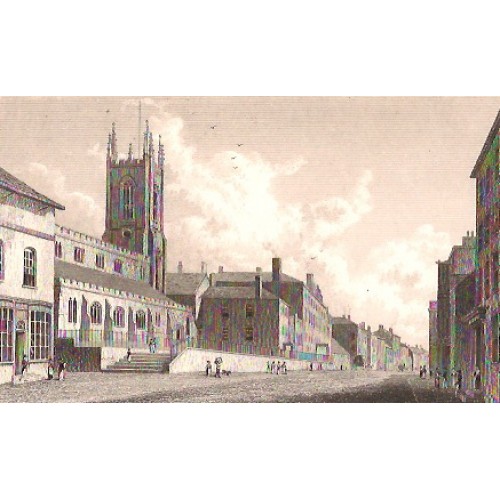
Preston - Church Street - Old Engraving


This historical image is looking down Church Street towards Fishergate.   The raised walkway complete with iron railings outside the Parish Church has long since disappeared.
Drawn by W.Westall. A.R.A.    Engraved by Edwd. Finden.

Find out more about the heart of Preston in our FREE tour of the ancient Flag Market on www.obelisktours.com

Tour Description:
"This FREE tour explores centuries of change around Preston’s Flag Market.  We find the remnants of Bull baiting, the stories behind the ancient Obelisk, the religious meaning behind the Lamb and the Flag, and the transformation of the Shambles.   Our tour discovers the majesty of the Harris Museum and the Age of Pericles, the ‘skyscraper’ of Preston, and Edwardian grandeur. "

Thursday, 6 August 2015

Preston Guild


Blacksmiths in the Trade Procession
Preston Guild 1882
What is a Guild?

Guilds were established throughout England to regulate local trade and served for centuries as the economic heart of communities. Guild members received trading privileges, political power and social prestige, and controlled their trades by administering fines and punishments, including confiscating the goods of any ‘foreign’ traders.

Once every twenty Years
It became necessary to monitor who was entitled to the privileges of Guild membership, and thus began the ancient tradition of convening a Guild Court to renew those rights. The Preston Guild determined that a renewal once a generation, or every twenty years, would be sufficient.

We are not sure when the first Preston Guild was held. King Henry II gave Preston a charter in 1179, so there at least 800 years of history. The first surviving Guild Rolls are from 1397, so the 2012 Preston Guild will be only the 28th held in the last six centuries – which is why locals use the phrase ‘once every Preston Guild’ when a bus is late or a teenager says thank you.

A Rare Survival

By the middle of the eighteenth century free trade was rapidly creeping into the nation’s economy which made the Guild’s role increasingly irrelevant. By the end of the century Guilds were considered by many as redundant, which was confirmed by the 1835 Municipal Corporations Act which officially abolished all Guild powers.

In most towns and cities the Guilds just evolved into a new form of local government, and their Courts, rolls, and celebrations disappeared into the mists of antiquity. Yet Preston’s Guild continued, even though the reasons for its existence had disappeared, and it had neither legs or teeth to regulate or influence. The amazing fact is that Preston is the only surviving Guild Court in the whole nation.

Why?

What did Preston see in the Guild that was worth preserving and celebrating?

First is a sense of tradition. There is something quite magical to think that the hundreds of people who renew their ‘rights’ in 2012 are doing so in the same fashion as their forefathers did in 1397. It is a delightful link to the past.

Secondly it is fantastic for trade. Originally Guild members promenaded to display their position and rights. Now the Guild provides businesses with an unrivaled opportunity for publicity. The past two Guilds have seen around a million people descend on Preston during the week long celebrations, and that does wonders for the local economy.

Thirdly it is a perfect excuse for some fun. Entertainment has always been big on the agenda for a Preston Guild. Since the 1842 Guild a major difference was the change of focus as a celebration for the whole community rather than elitist activities for a privileged few.

Over the years there has been a dizzying array of activity including: horse racing, cock fights, football, pipers, fiddlers, trumpeters, processions, promenades, hot air balloon ascents, balls, banquets, concerts, recitals, plays, assemblies, circuses, wild beasts, fairgrounds, and fireworks. No wonder that an 1822 visitor declared that Preston “presents an appearance of so much gaiety and bustle as to defy description.”

In 2012 the whole city once again erupted into a phenomenal array of colour and sound and activity. Don’t miss your next chance to be part of history and witness this unique and exciting spectacle.... in 2032!   Put it in your calendar.

See our Preston Guild Walking Tour
 Join us as we explore Preston's town centre and discover tales from Guilds past.  Visit www.obelisktours.co.uk.

Thursday, 5 March 2015

Preston - St Wilfrid's Banner


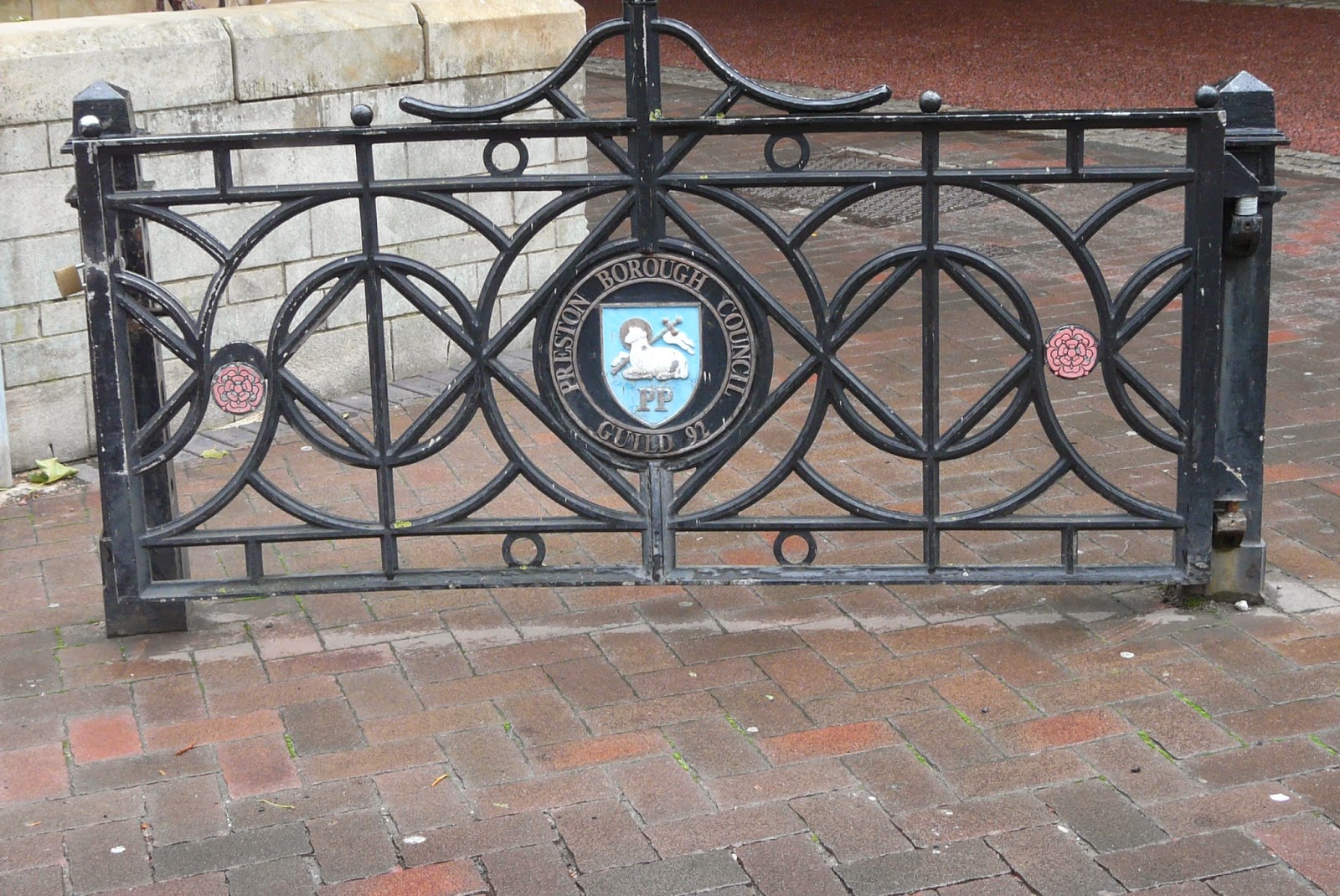
Carved in stone on the south side of the Obelisk in Preston's market square is St. Wilfrid’s Banner.    Saint Wilfrid (634-709 AD) was Bishop of York, and Preston was put under his authority in 670.  The word Preston is derived from the Old English words  “Preosta-Tun”  meaning “Priest’s Town”.    Wilfrid’s banner, The Lamb and Flag,  became the community symbol and can now be found all over the City on lampposts, stonework, pavements, and litter bins. 


The lamb represents the Lamb of God, and the Flag is the banner of truth.   The “PP”  represents the Latin words “Pinceps Pacis” meaning “Prince of Peace”.


This expression comes from Isaiah 9:6 which reads: 


"For unto us a child is born, unto us a son is given: and the government shall be upon his shoulder: and his name shall be called Wonderful, Counsellor, The mighty God, The everlasting Father, The Prince of Peace."


This is an excerpt from the FREE tour Preston Flag Market found on www.obelisktours.co.uk

Tuesday, 23 December 2014

282 years old today!

Richard Arkwright was born in Preston on the 23 December 1732 and became one of the most important figures in the industrialisation of Britain.   He was the youngest of thirteen children, and for a while he lived in this house located in Stoneygate in Preston


Arkwright House, Preston
Behind the tree!
I like the following descriptions of him.  The writer/ historian Thomas Carlyle (1795-1881) wrote:
“Richard Arkwright, it would seem, was not a beautiful man, no romance hero with haughty eyes, Apollo lip and gesture like the herald Mercury; a plain, almost gross, bag-cheeked, pot-bellied, Lancashire man, with an air of painful reflection, yet also of copious free digestion; a man stationed by the community to shave certain dusty beards in the northern parts of England, at a halfpenny each. .....Nevertheless, in strapping of razors, in lathering of dusty beards, and the contradictions and confusions attendant thereon, the man had nothings in that rough head of his; spindles, shuttles, wheels and contrivances plying ideally within the same.....His townsfolk rose in mob around him, for threatening to shorten labour, to shorten wages, - so that he had to fly, with broken wash-pots, scattered household, and seek refuge elsewhere. Nay, his wife, too, as I learn, rebelled; burned his wooden model of his spinning wheel, resolute that he should stick to his razors rather, for which however, he decisively, as thou wilt rejoice to understand, packed her out of doors. O reader, what a historical phenomenon is that bag-cheeked, pot-bellied, much enduring, much inventing barber!.....it was this man that had to give England the power of cotton.” (Hardwick, p 372)
R.S. Fitton (biographer) wrote of him:
The founder of the factory system, he was the creator of a new industrial society that transformed England from a nearly self-sufficient country with an economy based on agriculture and domestic manufacture, into the workshop of the world.” (Hunt 143)
And Arkwright certainly made a pretty penny out of the process. A 1785 newspaper reported:
It is remarkable that the great mechanic, Arkwright, was a barber and a few years ago shaved for a penny. His astonishing machine brought him one year a revenue of £70,000, and though he has lowered his prices to crush his rivals, his profits are yet between £40,000 and £50,000 a year. Universal Daily Register, January 1785
In today's money that would be equivalent to a revenue of £7 million and profits of £4 to 5 million plus. In a period of a few short years he shot to one of the world's wealthiest men. The brilliant Erasmus Darwin (1731-1802) described his inventions as having been productive of greater commercial advantages to this country, and contributed more to the general benefits of mankind in so short a period than any other single effort of human ingenuity. (Aspin, p. 5)

His impact on the industrial world was incredible. Others called the machines 'Stupendous' 'magick'. And it was not just a case of the machines being so much faster they also produced a thread that was "a many times stronger and leveller". This uniform quality of yarn made the weaving so much finer and sought after.

Anyway...happy birthday Richard.