Today we visit a hidden treasure in Oxford.
Each Oxford college has its own library with many beautiful and significant antiquarian books. On one of our group visits to Oxford we were privileged to get a behind the scenes tour of the impressive collection of the Harris Manchester College with books dating back to the seventeenth century.

The College began life in 1786 as the Manchester Academy based in Manchester. At that time Oxford was for the education of Anglicans only, so the Academy provided further education for non-conformists. It moved to York in 1803, back to Manchester in 1840, down to London in 1853, and finally settled down in Oxford in 1889. In 1996 it was renamed Harris Manchester in honour of Philip Harris (1942- ) who’s carpet wealth has richly benefited the college.

These were some of the highlights from their library collection:
- The Dutchman, Erasmus (1466-1536) had been invited to teach Greek at Cambridge University (the Other Place!), and while in England he translated the Bible from the original Greek - a work now considered one of the most important early documents of the English Reformation.
 |
| A column of original Greek with a revised Latin translation |
Erasmus also promoted the converting of scripture into local languages. He said,
"I totally disagree with those who are unwilling that the Holy Scriptures should be translated into everyday languages and read by unlearned people."
- That message resounded deeply with the likes of Martin Luther in Germany who, in 1522, released this German translation of the New Testament.
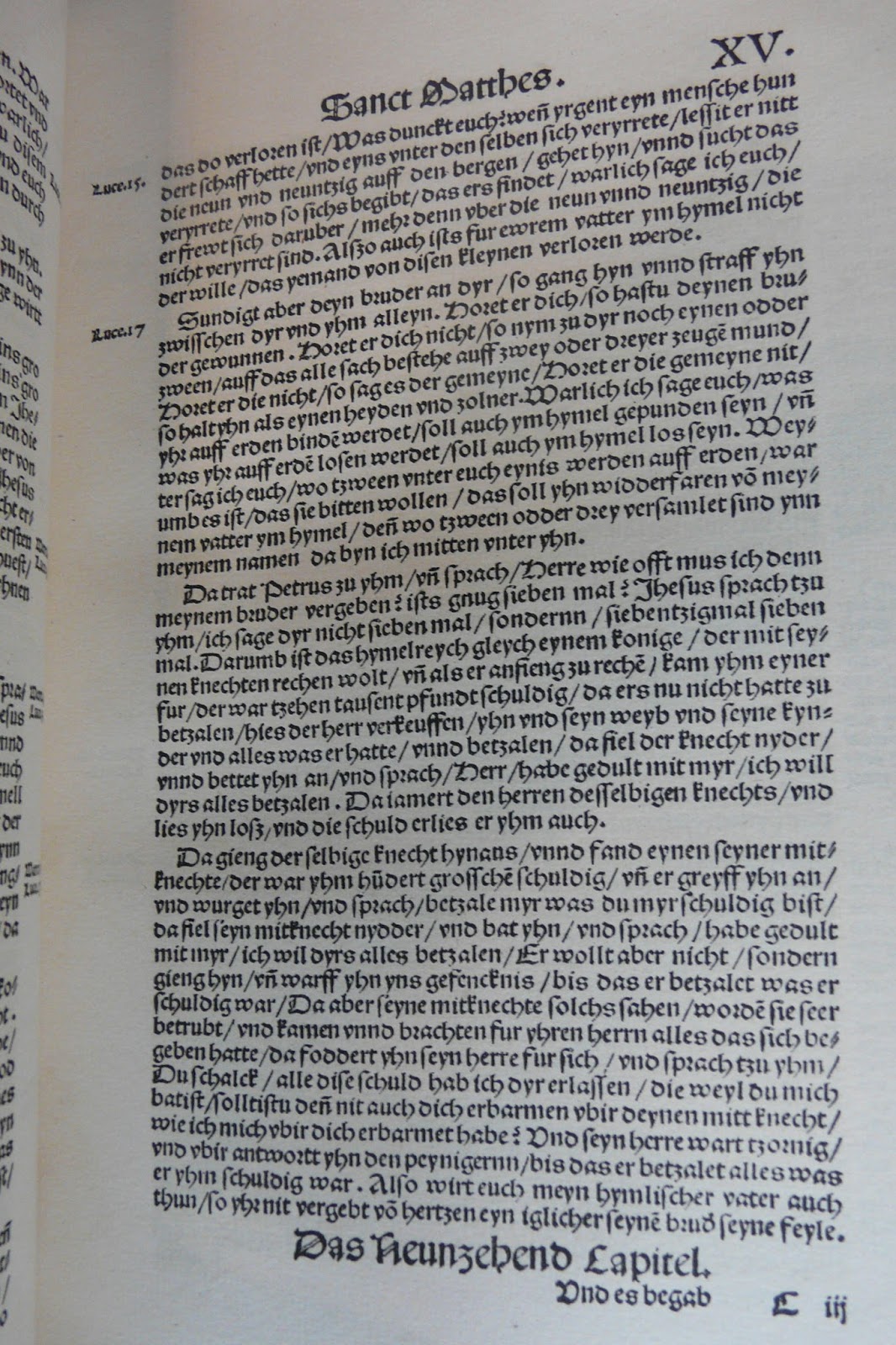
- The 'Great Bible' was published in 1539 by Miles Coverdale. Two years earlier the Matthew Bible had been released - in English - but it contained some marginal notes which many Church leaders found unacceptable. Coverdale's version eliminated those remarks.

- This 1578 edition of the Bishop's Bible is sometimes called a Treacle Bible because Jeremiah 8:22 reads "Is there not treacle at Gilead?" In subsequent editions treacle became "balm", but historically 'treacle' referred to an antidote to poison.

- This 1613 book "An Introduction to a Devout Life" is made especially valuable as Charles Wesley's signature is in the front (dated June 5, 1734),


- They also have Charles Wesley's glasses.

- And finally Sir Isaac Newton's famous work Principia (1687) - one of the most important science books of all time. This monumental work which first explained the laws of gravity was brought to us due to a book on fish. To find out what that is all about you'll have to join us next Monday when "On the road..." takes us to Cambridge.

These books and the Harris Manchester Library are not open to the General Public, but more details about the people, places and events associated
with these sites can be found on the tour Oxford’s Noble and Great Ones - Part 2 available
on www.obelisktours.co.uk

