Showing posts with label Liverpool. Show all posts

Tuesday, 12 April 2016

Liverpool - Mersey - Old Engraving


Liverpool from the Mersey 1829
This is one a series of images drawn from the River Mersey which capture a bygone Liverpool.
The original engraving included this comment:  "Commencing at the Ship-Building yards, and ending at the Herculaneum Pottery."

Liverpool built its own ships for 200 years.  Canadian shipbuilders, with their ample supply of wood, soon overshadowed their output, so many Liverpool merchants had Canadian ships.    The need for dock space on the Liverpool coastline eventually pushed shipbuilders over the river to the Birkenhead side where shipbuilding continues to this day.   The last large Liverpool ship was built in 1899.  
The Herculaneum Pottery was established in 1793 and continued to trade until 1841. They had a group of about forty potters and named their little settlement Herculaneum after the Italian city which, like Pompeii, was destroyed by the eruption of Mt. Vesuvius.

Drawn by S.Austin, Esq.  & Robt Wallis, Direxit

Published by Fisher Son & Co., London 1829.

We have a series of tours of Liverpool available.  There is a FREE tour of the Pier Head, another tour around the cultural heart of the City, a tour of Albert Dock,  plus two LDS tours.   Find out more details on www.obelisktours.co.uk

Tuesday, 29 March 2016

Liverpool - St George's Basin - Old Engraving


Liverpool - St George's Basin, 1841

This engraving captures how the Pier Head in Liverpool orginally looked when it was St. George's Basin.

The ships masts in the distance are docked in Prince's Dock.  Off picture to the right would be George's Dock.   The basin and George's Dock were drained in 1899 and the Three Graces of Liverpool's Pier Head began to appear starting in 1903.  The Church depicted is St. Nicholas which still stands, but is obscured from view by modern buildings.
 Standing at this spot today you would be looking at the Pier Head with the Ferry Building on your left and the Liverpool Museum and the Royal Liver Building hiding St. Nicholas Church.

From a Steel Engraving By W.H. Barflett & J.C. Armytage

Published by Geo Virtue, 26 Ivy Lane, London, 1841

You can explore this area in detail on our FREE tour of the Pier Head on www.obelisktours.com

Tour description:  
"This FREE tour of Liverpool’s Pier Head unveils how this huge port became the world’s busiest trade centre and “one of the nineteenth century’s greatest success stories.”  As we wander around the Pier Head we will discover the history behind this area and its buildings as well as finding horses and kings, museums and memorials, a church and a vanished dock, a canal system and a tunnel."

Tuesday, 8 March 2016

Liverpool - Princes Dock - Old Engraving


The Prince's Dock  c. 1840


This engraving depicts The Prince's Dock, which was Liverpool's first 19th Century dock opened in 1821.   The dock was named after the Prince Regent who became King George IV the same year the dock opened.

The Dock initially focused on North Atlantic Trade with North America.  Twenty years later it switched to South American and East Asian trade, and then by 1910 had moved to Irish trade.
This was the first dock to have security walls built around it to prevent theft. These walls can be clearly seen in this image.


By Harwood & F.R. Hay

Tuesday, 23 February 2016

Liverpool - Custom House - Old Engraving


Liverpool Customs House.  1840

This magnificent building (finished in 1839), served for a century as Liverpool's Custom House, Post Office and Telegraph Office.   

On the 3rd May 1941 the building was bombed by enemy planes.  The damage was extensive and the controversial decision was made in 1948 to destroy the rest of the building.  The building stood opposite the entrance to Canning Dock and the Albert Docks.  Today the site is part of the new One shopping mall.

Drawn by T. Allom.  Engraved by W. Finden.  Circa 1840.

Tuesday, 2 February 2016

Liverpool - River Mersey - Old Engraving


Liverpool - The Mersey 1840

This image is from a series of engravings depicting the River Mersey.  It shows the Port of Liverpool in full swing during the age of sailing ships.    The skyline of Liverpool is dominated in the centre by the parish church of St. Nicholas, and the Customs House to the Right of the picture.
By W. H. Bartlett & J.C. Armytage
Published by Geo: Virtue, 26 Ivy Lane, London, 1840.

Tuesday, 5 January 2016

Liverpool - Pier Head - Old Engraving


From the engraving of St. Nicholas' Church, Chapel Street, Liverpool, 1829.

Today St. Nicholas Church is landlocked, but this engraving illustrates how the docks once stood immediately outside its front door.  It truly was the Seaman's church as thousands of Sailors and emigrants would attend church here for the last time before setting out on their adventures around the world.

The majority of the nine million emigrants who emigrated from Liverpool left from St. George's Dock and Basin which stood in front of St. Nicholas.   The Royal Liver Building, The Cunard Building, and the Port Of Liverpool building now occupy the site of the old Dock.  The only hint of its existence is the name of the road: George's Dock Gates.

Drawn by G & C. Pyne.  Engraved by H. Jorden.  Published by Fisher, Son & Co., London, 1829

The engraving is dedicated to 'The Rectors The Rev. R. H. Roughsedge, M.A. and the Rev. Samuel Renshaw, M.A.'

This Liverpool Pier Head area can be discovered in greater detail in our FREE tour on www.obelisktours.com

Thursday, 22 January 2015

Lancashire: Preston Poverty

Many Victorian visitors to Preston were struck by the poverty of the cotton workers.

Religious ministers from Reverends to Mormon missionaries were understandably appalled at the living conditions they encountered.  On their first day in Britain in Liverpool (1837) Heber C. Kimball recorded,
"...wealth and luxury abound, side by side with penury and want. I there met the rich attired in the most costly dresses, and the next minute was saluted with the cries of the poor with scarce covering sufficient to screen them ...


Upon arriving in Preston he witnessed some even more dramatic scenes:
"Such sufferings I never witnessed before. The scenes which I daily beheld were enough to chill the blood in my veins. The streets were crowded with men, women and children who begged from the passengers as they walked along. Numbers of the poor, wretched beings were without shoes or stockings, and scarcely any covering to screen them from the inclemency of the weather; and daily I could discover delicate females walking the streets gathering up the animal refuse, and carrying it to places where they could sell it for a penny or half-penny. And thus they lived through the winter." (Whitney, p. 189)

In a letter to his wife, Orson Hyde observed:
They are extremely poor, most of them not having a change of clothes decent to be baptized in, but they have open hearts and strong faith. We have taught them nothing about the gathering for they have no means to bring them to America, let alone procuring a place…. The brethren will frequently divide the last loaf with us, and will do all in their power for us… They are very kind to us where we are, but their circumstances will not allow them to do much for us without pay. I have frequently seen the tender and delicate females with their old pails or baskets in the streets gathering up fresh horse dung with their naked hands, and then go and sell it and get a penny or two’s worth of bread for themselves and hungary [sic] children… (Barron p. 97)

In January 1840 Wilford Woodruff arrived in Preston and observed:
The streets were crowded with the poor both male and female going to and from the factories with their wooden clog shoes on, which make a great rattling over the pavement. The poor are in as great bondage as the children of Israel in Egypt. (Woodruff, p.405)
So...
the above quotes are the voices of Mormon missionaries. What about the other voices? What were local observations of these same scenes? I'm just going to share one quote with you today for you to compare.

The following comes from the pen of Rev. J. Johns of Liverpool as recorded in Joseph Livesey's paper the Moral Reformer printed in Preston on Jan. 27, 1838:
"Within these few months, I have seen, what, had I not seen it, I could not have imagined.  ...Few could have seen the scenes which have passed under my eyes (especially during the month of the late trying winter) without feeling that the times has indeed arrived, when man should go forth to the relief of his brother.
Mothers, newly become such without a garment on their persons, and with infants nearly as naked, lying upon straws or shavings, under a miserable covering, without fire or food, or the means of precuring them; children taken from their schools, in order to earn by begging...
...mothers of families only able to provide necessities for their children by pawning their little all, or by incurring debts whereever they could be trusted.
...infirm and aged people, who were shivering out the last hours of life in absolute want of everything that could sustain or endear it.
Sobering stuff!!

More quotes and details can be found in the FREE app tour of Preston Flag Market  and, for an in-app purchase, the tour of LDS Preston.  Both tours can be found via www.obelisktours.co.uk

Sources
Barron, Howard H. Orson Hyde: Missionary. Apostle. Colonizer. Horizon Publishers, Bountiful, Utah (1978)
Livesey, Joseph. The Moral Reformer. Preston Jan. 27, 1838 p. 26
Whitney, Orson. Life of Heber C. Kimball. Bookcraft, Salt Lake, Utah (1888)
Woodruff, Wilford, Wilford Woodruff Journals, edited by Scott G. Kenney. Midvale, Utah, Signature Books, 1983.

Thursday, 8 January 2015

Liverpool - Waiting

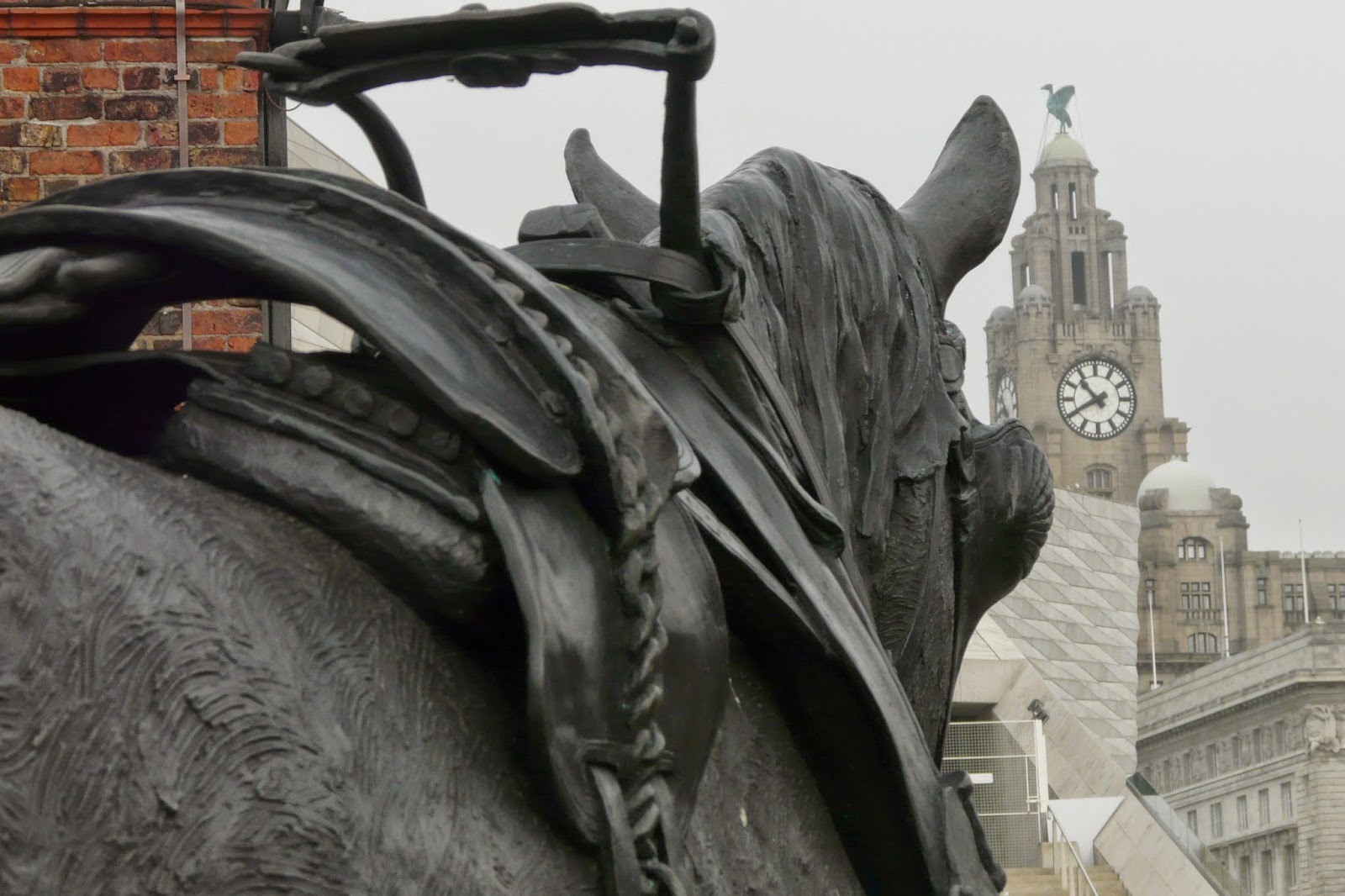
In our world of fast cars, trucks and planes and trains we tend to forget how the horse was once a vital part of the whole system of commerce.    By the late 1800s there were over 3 million horses working in Britain. 
This monument pays tribute to the working horse and points out that at their peak more than 20,000 horses worked on the streets of Liverpool.

 The monument gives a taster of the loads these beasts of burden once carried:

Bags of seed, tea, groundnuts, cotton, rubber, dried fruit, rum, canned goods, rice, butter, tobacco, timber, billets, linen, saltfish, red oxide, yellow ochre, bales of dry/wet hides, carbon black, steel coils, steel girders (7 tons), casks of beer, milk powder, holloware, bodies, bundles of hessian, bags of Demerara sugar, and more…


For over 250 years there was an army of occupations depending upon the horses for their livelihood such as blacksmiths, farriers, ostlers, carters and wagon builders. 
 Imagine the sound, sight and smell of thousands of horses moving around these docks and streets - the clattering of metal hooves and wheels on stone, the neighing, hollering and cajoling, the whiffs of sweat, damp and pooh.  The average horse would produce around 25 pounds of manure a day.


This delightful bronze statue was a result of the Retired Carters Association who were concerned the history of the working horse would be forgotten.    The statue, by Judy Boyt, is called Waiting showing the obedience of these powerful creatures.    It was unveiled May 2010.  

This monument is included in the FREE tour of Liverpool Pier Head available from www.obelisktours.co.uk

Thursday, 1 January 2015

Liverpool - Mersey Tunnel

Today we are going to look at a ventilation shaft. 

 Hold on....do not click out yet.  It might sound rather mundane, but this little treasure is one of Liverpool's oft-ignored Art Deco treasures.   

Background to the Tunnel

At the time of its construction in 1925 the Mersey Tunnel  was the largest underwater tunnel in the world.   Four lanes of traffic run under the River bringing Birkenhead and North Wales within easy reach of Liverpool.     The official opening ceremony took place nine years later in 1934 when Queen Mary and King George V arrived to ‘cut the ribbon’ and open the tunnel for use.   A second tunnel under the River Mersey was opened by Queen Elizabeth II in 1971.

Our Art Deco Treasure

All the tunnels needed ventilation and this building, by Herbert James Rowse (1887-1963),  is the finest of those shafts.  Thousands drive by this every day without giving it a second glance, but I highly recommend you park the car and take some time walking around all four sides.  
 
 The large rectangular building is one of three ventilation shafts to the tunnels on this side of the river.  If you stand by the River you can look across the river and see three similar shafts on the Birkenhead skyline.  This building is not only extracting all the car fumes out of the tunnel, but also pumping clean air in.  It also doubles up as offices and a control centre.

But it is the little things that bring this building to life.   


 There are some rather abrupt slashes of green around the building which at first jarred me, then, gradually, as I warmed to the building's design I accepted what had initially seem like an intrusion.  The contrast between the light earthy Portland stone and this flash of colour strangely began to complement each other.

 
On the main road side is a sobering reminder of the lives that were lost creating the tunnel.


  If you walk around this building you will discover some nice sculpture work by Edmund Charles Thompson (1898-1961) and George T. Capstick including:

‘Speed’ with his helmet and goggles representing the thousands of cars motoring deep beneath our feet.


‘Night and Day’ representing the ever open tunnel running 24/7 with the sun in the lap of the first, and a star in the second.  

  Sculpted panels representing Engineering, Construction, Architecture and Decoration

This is one of the many fascinating buildings and stories to be found around Liverpool's Pier Head.  To find more Liverpool treasures download our FREE tour of Liverpool's Pier Head on www.obelisktours.co.uk 

Thursday, 18 December 2014

Liverpool - Titanic


Even though the ill-fated Titanic never visited Liverpool it has many connections to the City.  First of its owners were the White Star Line whose main office was in this red and white striped building called Albion House or the White Star Building (built 1898).  The ship was registered here which resulted in the words Titanic, Liverpool being painted clearly on its stern. 

Most of the Titanic's crew were from Southampton, but there were Liverpool staff who lost their lives.    These included  John Thompson and Thomas Threlfall as Firemen,  Mr. Pallas as a Greaser,   Henry Ashe, William Carney, Thomas Hewett, Charles Hogg, Thomas Holland, Andrew Latimer, and Thomas Weatherston as stewards,  Elizabeth Leather and Sarah Stap as stewardess,  James Hutchinson as a Vegetable Cook ,  Charles Morgan as a storekeeper, Charles Proctor as a Chef and John Clarke as a Bassist.   Not surprisingly concerned family and friends gathered on the streets outside these offices to hear any news of their loved ones.   Officials read names of the deceased from the balcony.

In 1934 the White Star Line moved over the street to merge with the Cunard Line.  Cunard continued to use the expression White Star Service to highlight their commitment to high levels of customer care.  
   
In 2013 the building was purchased by Signature Living to turn it into a Hotel complete with a Titanic Pool and Spa and a roof top bar and restaurant with World Heritage Views.   You can stay in The Vault Cabin – the very room where the Titanic's plans and documents were stored,  The Lightoller Suite – named after a first class officer, The Molly Brown Quarters – after the unsinkable Molly Brown, The William Hartley Quarters – after the  famous Lancashire bandmaster who played on,  and The Guggenheim Quarters – named after the  Gentleman who returned to his quarters. 


There are many more Titanic connections plus a variety of other rooms named after other White Star Line ships. 

Engineer's Memorial 

When the Titanic struck an iceberg in April 1912 it sank with 1514 souls, and sent shockwaves around the world.  It was the 9/11 of its day, and a century later the tragedy still resonates with horror.  This monument was originally planned as a tribute to the 224 engineers of the Titanic, those often unsung heroes who work deep in the bowels of the ship.  Eventually its scope was broadened as a Memorial to all the Heroes of the Marine Engine Room who are lost at sea.   Admittedly for all those boarding their cruise ships here an Engineer's Memorial sounds less ominous than a Titanic Memorial. 

 When this was unveiled in 1916 it was a pioneering work as there was no British sculpture that recognised the contributions of the working class.


The four nude figures represent Earth, Air, Fire and Water.

Incidentally this was carved by William Goscombe John who also created the equestrian statue of  King Edward VII located in the middle of the Pier Head.
Around the monument you can see World War Two shrapnel damage from exploding bombs.
This is one of the many monuments and buildings to be found in the FREE tour of Liverpool Pier Head found on www.obelisktours.co.uk

Thursday, 11 December 2014

Liverpool - The Liver Birds

The Liver Bird is a mythical creature, so any birdwatchers hoping to catch a glimpse of one will have a very long wait.  Historians often trace its lineage to a coat of arms made over 700 years ago which displayed the eagle of St. John the Evangelist.    So someone’s really bad drawing of an eagle evolved into a make believe bird that has become Liverpool's symbol. 

 The two enormous Liver Birds on top of the Royal Liver Friendly Society building are here because the Friendly Society adopted them as part of their company logo and this is their HQ.


 There are some funny local legends attached to these two birds.

The one looking out to sea is supposed to be female since she is waiting to see when the sailors are coming in.  The bird facing towards the City is male because he is waiting to see when the pubs will open.
   

There is also a legend that if an honest man or a virtuous woman ever walks besides the Liver building the Liver birds’ wings will flap.  They have yet to move.


It is also claimed that if they were to fly away the City of Liverpool would fall.  You will note they have been tied down to prevent them leaving… or are those just support lines?  You decide. 

This is an excerpt from the FREE tour Liverpool: Pier Head found on www.obelisktours.co.uk

Thursday, 4 December 2014

Liverpool - 5 Pier Head Memorials you must not miss

The Pier Head in Liverpool is full of memorials and these are the pick of the bunch.  Make sure you find them when you visit.   If you want to know the stories behind them you can download our FREE tour app of Liverpool Pier Head on www.obelisktours.co.uk  
"Waiting" by Judy Boyt

Cunard War Memorial by Arthur Davis

Memorial to Alfred Lewis Jones - Ship owner and Tropical medicine benefactor.


Merchant Navy War Memorial

The Engineers or 'Titanic'  Memorial